Skip To Content

Educational Improvement Tax Credit (EITC) 

Transform your annual tax obligation into a powerful force for educational change in our community. Through Pennsylvania’s Educational Improvement Tax Credit (EITC) program, forward-thinking businesses have the extraordinary opportunity to directly shape the future by investing in innovative educational initiatives right here at Cedar Crest College. Not only is this smart tax planning—with substantial credits of up to 90%—it’s also about recognizing that every student who benefits from our dual enrollment programs, STEAM camps, and hands-on learning experiences represents a future leader and community contributor. When your business participates in EITC, you actively choose to bridge educational gaps, inspire young minds, and create pathways to success while strengthening the very communities where your business thrives. 

What is EITC? 

EITC is a program created through the Pennsylvania Department of Community and Economic Development (DCED) for businesses to directly contribute to K-12 educational programming. EITC business participants are eligible to receive tax credits by donating to qualified Educational Improvement Organizations (EIO) like Cedar Crest College. Through these donations, Cedar Crest enhances our mission of educating the next generation of leaders for life in a global community.  

Who is Eligible?  

Companies that apply and register with DCED, are authorized to do business in Pennsylvania, and are subject to one or more of the following taxes: 

  • Personal Income Tax 
  • Capital Stock/Foreign Franchise Tax 
  • Corporate Net Income Tax 
  • Bank Shares Tax 
  • Title Insurance & Trust Company Shares Tax 
  • Insurance Premium Tax (excluding unauthorized, domestic/foreign marine) 
  • Mutual Thrift Tax 
  • Malt Beverage Tax 
  • Surplus Lines Tax 

What is the Benefit?  

Businesses can support pre-approved initiatives with their tax dollars, making a greater impact and reducing their tax liability by receiving tax credits through Pennsylvania. These tax credits are equal to 75% of the contribution up to a maximum of $750,000 per taxable year. This can be increased to 90% of the contribution if the business agrees to provide the same amount for two consecutive tax years. Tax credits may be applied against the tax liability of a business for the tax year in which the contribution was made.  

How to Apply? 

If you are not already registered through the DCED, simply visit the Educational Improvement Tax Credit Program page to complete the application. Use the Business Application Guide for specific details on eligibility and the application process. 

Educational Improvement Organization (EIO) 

Cedar Crest College is a designated EIO under the EITC program. Cedar Crest offers three “innovative educational programs” to advance the curriculum and academic programs of our local public schools and community. These initiatives are described below.  

**For more information on Educational Improvement Organizations, please review the Organization Guidelines provided by EITC** 

Eligible Initiatives at Cedar Crest College 

young person looking at a laptop and taking notes

Dual enrollment courses are designed for high school students to provide a jump start on a program at Cedar Crest College or transfer into another college or university of a student’s choice. 

High School students have two dual enrollment options at Cedar Crest College: 

Early College 

High school juniors and seniors can kickstart their degree with Cedar Crest’s Early College program. In this traditional dual enrollment program, female-identifying students attend classes on campus, choosing from a wide array of courses from Cedar Crest’s undergraduate catalog taught by Cedar Crest faculty. These include daytime, evening, and weekend options, all offered at reduced tuition rates.  

Dual Credit Academy 

Cedar Crest College has partnered with Tel® Education to create a Dual Credit Academy. Tel® Education is a non-profit organization committed to facilitating equitable access to high-quality, affordable learning in the U.S. In Cedar Crest’s Dual Credit Academy, high school students (male and female) from across the state can take a variety of online courses for college credits that transfer to a variety of colleges and universities.  

Click here for more information about Dual Enrollment Admissions and Aid!

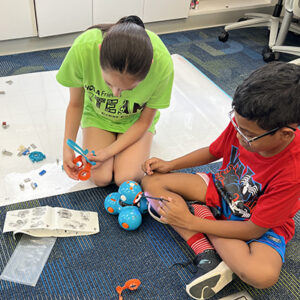
Children working together

HOLA Friends STEAM Camp engages students from grades 3 to 5 in immersive, hands-on STEAM (Science, Technology, Engineering, Arts, and Mathematics) experiences on the campus of Cedar Crest College. The camp’s unique approach is rooted in project-based learning. It follows the engineering design process, ensuring that students grasp theoretical concepts and apply their knowledge in real-world scenarios. The HOLA Friends program and curriculum are designed to provide career awareness and empower the leaders of tomorrow. 

The program is built on the following anchors: 

  • STEAM: Solving STEAM challenges by connecting social learning and the engineering design process.  
  • 21st Century Skills: Promoting effective communication, collaboration, critical thinking, problem-solving, cultural awareness, and effective use of technology along with resiliency, determination, perseverance, and intrinsic motivation. 
  • Cognitive Skills: Building critical thinking, logical reasoning, active listening skills, and interpersonal competencies such as collaboration, cooperation, leadership, responsibility, social influence, and assertive communication.
  • Hands-On Learning (HOLA): Enhancing collaboration skills via the engineer design process model through a series of steps to design unique prototypes. 
  • Growth Mindset: Creating a learning space that promotes self-efficacy, self-esteem, and self-concept and learning to view challenges as opportunities. 
  • Social-Emotional Learning: Developing language skills, social interactions, and behavioral actions to communicate ideas.  

STEAM lessons focus on electrical engineering, coding, and technology. This gives students the chance to explore cutting-edge fields in a creative and collaborative environment. Lessons are structured to challenge students’ critical thinking while fostering a deeper understanding of how different STEAM fields intersect.  

The camp runs from Monday-Friday, 9:00 a.m.-3:00 p.m. over three weeks in July. Read more about HOLA STEAM Camp here.

Each year new activities are available for returning students while reinforcing the concepts of electrical engineering, coding, and technology. This adaptability keeps students engaged and challenged, with new activities providing additional layers of complexity and creativity.