Skip To Content
Loading…

We see you providing quality healthcare to the next generation of learners in a school setting. Our online multi-disciplinary School Nurse Certification (SNC) program will provide you with the necessary knowledge and practical skills to serve the needs of school-age children and adolescents.  

Upon graduation, you will meet the requirements of the PDE for Level 1 School Nurse Certificate. 

Our SNC program is available to complete fully online, with the exception of your 105 clinical hours, in as little as three semesters so that you can take your nursing career to the next level with the flexibility you need to succeed. 

The SNC is a state-based certification and is designed to meet the requirements of the Pennsylvania Department of Education (PDE) for Level I School Nurse Certification. Other states may accept this program for full or partial completion of that state’s requirements. To determine if a state other than Pennsylvania will accept this program, please contact the Department of Education in that state.  

Why Apply to Cedar Crest College’s Online SNC Program?

  • Flexibility: Coursework is offered in an online, providing the flexibility you need to manage school & life.
  • Our Reputation: When you become a part of our School of Nursing, you become part of a long tradition of modern nursing. Cedar Crest nurses are known throughout the area for their competence, care, and compassion.

Prospective and current nursing students must submit criminal background checks that meet the requirements of the nursing program before beginning clinicals and annually thereafterProspective nursing students with criminal records must disclose their record and schedule a meeting with the Nursing Department Chairperson upon admission to Cedar Crest College.  

  • EDU 559- Curriculum and Instruction for the English Language Learner (3 credits)  
    • OR EDU 516- Multicultural and Diversity Education (3 credits)   
    • OR MSN 531 – Curricula in Nursing Education (3 credits) 
  • SPE 541- The Exceptional Child: Special Education Process: PreK-Transition (3 credits)  
  • SPE 544- Adaptations, Modifications, and Assistive Technology (3 credits)  
  • SNC 500- Methodology in School Health Services (3 credits)  
  • SNC 505- School Nurse Practicum (5 credits /105 clinical hours)  

All candidates for the school nurse certificate, both in-state and out-of-state, must take SNC 500 and 505 in sequential order and within one academic year.  

The Capstone courses are a pair of courses (SNC 500 + SNC 505) offered in the fall and spring terms of one academic year. They are taken as a set in that academic year and are online. During SNC 505 in the spring term, students complete a practicum experience in school nursing. This experience includes 105 hours of practice in conjunction with a certified school nurse in a school district chosen based on student request and the college’s ability to establish an affiliation with that school district. Students will practice at one primary level but also complete some hours at all other levels.  

The Pennsylvania Department of Education requires the following for certification in PA:  

Six credits of college coursework in mathematics; three credits in English composition; and three credits in American or British literature. Cedar Crest College requires that the student has earned a grade of C or higher in these courses. 

The Pennsylvania Department of Education requires all candidates to have a bachelor’s degree in nursing or a bachelor’s degree in another field with RN (Registered Nurse) licensure. All students must provide proof of RN licensure from the state in which they will complete their practicum and to which they are applying for certification. In addition, the following clinical requirements must be completed before the clinical practicum experience:  

  • Report of Health Evaluation and Medical History 
  • Immunizations, Titers, and Current PPD 
  • Drug and Alcohol Screen 
  • CPR certification – Must be one of the following 
  • American Red Cross CPR/AED for Professional Rescuers and Health Care Providers 
  • American Heart Association Basic Life Support for Health Care Providers 
  • Proof of Health Insurance 
  • FBI Criminal History Clearance 
  • Child Abuse History Clearance 
  • PA Criminal History Clearance 

The technical standards for the Cedar Crest College School of Nursing outline the essential skills and competencies required for both undergraduate and graduate nursing students to provide high-quality, compassionate patient care. These standards emphasize the acquisition of both foundational and advanced knowledge in clinical reasoning, healthcare systems, and evidence-based practice. Undergraduate students must demonstrate the ability to synthesize information, communicate effectively, and apply clinical judgment in patient care. Graduate students build on these skills by integrating complex theoretical knowledge, analyzing data, and making informed, evidence-based decisions. Both levels require proficiency in using technology, patient-centered care, and maintaining professionalism and lifelong learning. Students must also be able to perform essential technical skills and procedures, with accommodation provided as necessary to support individual needs and ensure equitable access to meet these requirements. The College provides reasonable accommodations to students on a nondiscriminatory basis consistent with legal requirements as outlined in the Americans with Disabilities Act (ADA) of 1990, the Americans with Disabilities Act Amendments ACT (ADAAA) of 2008, and the Rehabilitation Act of 1973. If you are an applicant with a disability who may require accommodations in our program, we encourage you to contact Student Accessibility Services at  for a confidential consultation.

Graduate Nursing Programs Technical Standards

Acquiring Fundamental Knowledge

  • Theoretical Foundations: Graduate nurses must successfully complete advanced education in subjects such as pathophysiology, pharmacology, and health assessment. This knowledge forms the basis for understanding complex patient care by delving into theoretical frameworks to develop effective clinical reasoning skills.
  • Current Research and Trends: Graduate nursing students must stay current with the latest research and emerging healthcare trends to provide high-quality evidence-based care. Critical appraisal, synthesis and translation of scientific evidence informs best practice.
  • Healthcare Systems Knowledge: Graduate nursing students must understand the structure, policies, and functions of healthcare systems to enable them to navigate the complexities of patient care within different settings.

Developing Communication Skills

  • Effective Verbal Communication: Graduate nurses must master the ability to communicate clearly and effectively with patients, families, students, preceptors and the healthcare team. This includes active listening, providing patient education, and navigating sensitive discussions with compassion and clarity.
  • Nonverbal Communication: Graduate nurses must recognize and effectively utilize body language, facial expressions, and other nonverbal cues as important for building rapport and ensuring understanding. This is demonstrated by congruency between verbal communication and nonverbal expression, with consideration of diverse cultural mores.
  • Documentation Skills: Graduate nurses must demonstrate proficient writing skills. This is necessary for accurate and thorough documentation of patient care, transitions of care, research, scholarship, and legal compliance.

Interpreting Data

  • Clinical Data Analysis: Graduate nurses must be skilled in analyzing and synthesizing clinical data from various sources, including patient histories, diagnostic tests, and monitoring systems. This involves identifying patterns and anomalies that inform care decisions.
  • Use of Technology: Graduate nurses must be familiar with electronic health records (EHRs) and data management systems, as well as adept at using technology to enhance data interpretation and patient care.
  • Quantitative and Qualitative Analysis: Graduate nurses must understand that the analysis of both quantitative and qualitative data is important for making comprehensive clinical assessments and engaging in research activities.

Integrating Knowledge to Establish Clinical Judgement

  • Holistic Assessment: Graduate nurses must be able to conduct thorough assessments that consider physical, psychological and socio-cultural factors affecting patient health. This holistic approach informs clinical judgment and decision-making.
  • Application of Theoretical Knowledge: Graduate nurses must integrate knowledge from various disciplines (nursing, medicine, psychology, sociology, education) into clinical practice to make informed decisions that are patient-centered and evidence-based.
  • Ethical and Legal Considerations: Graduate nurses must incorporate ethical principles and legal frameworks into clinical judgment to ensure that care decisions respect patient autonomy and adhere to professional standards.

Implementing and Evaluating Nursing Interventions

  • Evidence-Based Practice: Graduate nurses must be able to select and implement interventions based on the most relevant and current evidence. This includes utilizing clinical practice guidelines and evidence-based protocols to inform their actions.
  • Patient-Centered Care: Graduate nursing level care should be tailored to meet the individual needs and preferences of patients. This involves engaging patients in their plans of care and considering their values and beliefs.
  • Outcome Evaluation: Graduate nurses must evaluate the effectiveness of nursing interventions. Graduate nurses must be skilled in assessing patient outcomes, adjusting plans of care as necessary, and using feedback to improve practice.

Incorporating Appropriate Professional Attitudes and Behaviors into Nursing Practice

  • Professionalism: Graduate nurses are expected to demonstrate professionalism through reliability, accountability, and adherence to ethical standards. This includes maintaining patient confidentiality, advocating for patients’ rights and contributing to a safe, collegial workplace. Graduate nurses must uphold high standards of honesty, integrity, ethical behavior, and advocacy for the nursing profession as a whole within interdisciplinary teams.
  • Compassion and Empathy: Graduate nurses must be committed to providing compassionate care. Graduate nurses must cultivate empathy and understanding to address the physical, psychological and socio-cultural needs of patients.
  • Lifelong Learning and Adaptability: Graduate nurses must embrace a mindset of lifelong learning to adapt to the evolving healthcare environment. Graduate nurses should actively seek opportunities for professional development and be open to feedback and change.

Approved 8.6.2025

Dive A Little Deeper

Courses Required for the School Nurse Certification Program

All courses are offered Online

EDU 559 Curriculum and Instruction for the English Language Learner 3 credits
OR
MSN 531 Curricula in Nursing Education 3 credits
SPE 541 The Exceptional Child: Special Education Process: PreK-Transition 3 credits
SPE 544 Adaptations, Modifications, and Assistive Technology 3 credits
SNC 500 Methodology in School Health Services 3 credits
SNC 505 School Nurse Practicum 5 credits /105 clinical hours

All candidates for the school nurse certificate, both in state and out of state, must take SNC 500 and 505 in sequential order and within one academic year. Pennsylvania Department of Education (PDE) requires the following for certification in PA:

Six credits of college course work in mathematics; three credits in English composition; and three credits in American or British literature. It is a requirement of Cedar Crest College that the student earn a grade of C or higher in these courses.

Upcoming Admissions Events

Dec 10
  • Wed
  • 7:00PM – 8:00PM
Graduate Nursing Online Information Session Learn More
Feb 02
  • Mon
  • 7:30PM – 8:30PM
Accelerated BSN Information Session Learn More
Feb 25
  • Wed
  • 7:00PM – 8:00PM
Graduate Nursing Online Information Session Learn More

Cooperative Agreements

Cedar Crest College collaborates with several academic institutions to provide our students with innovative pathways that help them succeed in their chosen fields.

Cedar Crest Accounting Students in the Classroom

How To Apply

Ready to apply as a graduate student?
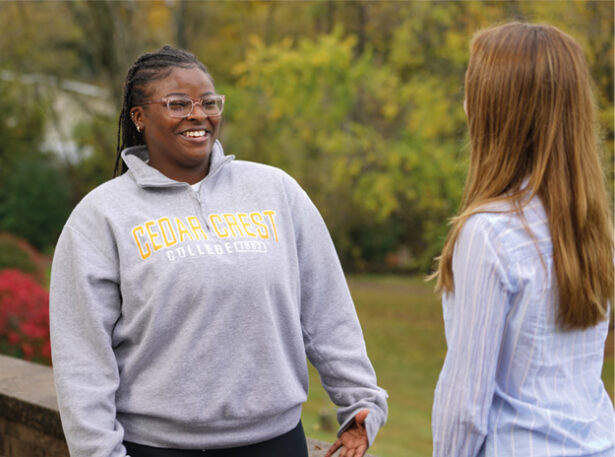
Cedar Crest student smiling on campus

Accreditation

The Pennsylvania Department of Education approves the certification programs within the Education Department at Cedar Crest College. The Pennsylvania Department of Education is the official state body that approves programs for professional certification in Pennsylvania.

Faculty & Staff

Who’s teaching you is as important as the curriculum you choose.
Let’s put a face to some of the names you’ll be seeing on the course listings!

Contact: