

Cedar Crest College is committed to providing students with ground-breaking opportunities to earn degrees that will transform their lives and make a difference in the world. That’s why we see you earning your Master of Science in Crime Science at the first graduate program of its kind in the nation.
Building on the strength of our undergraduate programs in Criminal Justice, Forensic Science, and Psychology, the Master’s in Crime Science takes an interdisciplinary approach to crime prevention and detection that differs from most system-centered criminal justice degree programs. The goal of the program is to create more effective practitioners by teaching skill-centered concepts that can be used professionally. Ultimately, Crime Science aims to teach practitioners, policy-makers and community activists how to collectively and collaboratively manage resources in a way that effectively prevents criminal behavior, or, alternatively, more quickly solves the crime that does occur.
This graduate program can be a natural next step to an advanced degree for individuals from a wide array of professional and academic backgrounds. The program may be of particular interest to prospective students who hold a bachelor’s degree and are employed, or seeking employment, in law enforcement, court and corrections professions, as well as those who work in client-based services such as drug rehabilitation, foster care and mental health organizations.
Program Delivery
This 36-credit graduate degree is a weekend-centered program designed to be more accessible to the working professional. It can be completed in as few as 18 months.
The skill-based curriculum – which covers environmental criminology, forensic science, and forensic psychology – is comprised of 30 credits assigned to 1-, 2-, and 3-credit learning modules delivered mostly in hybrid format, with 6-credits dedicated to the capstone project. Each module is designed to teach the practitioner a skill that can be directly applied to the professional setting. The capstone project is an application exercise where students must apply what they have learned and create, evaluate, or re-design a criminal justice program, intervention, community initiative, or policy position.
The dates, times and content of the modules are published in advance so that schedules can be managed more effectively. Much, if not all, of what is taught is directly applicable to any criminal justice-related organizations, so professionals in those fields may be able to receive training credit and release time.
This graduate program may also be completed as a 4+1 program for students in the traditional undergraduate women’s college.
Dive A Little Deeper
RN-BSN Virtual Info Session

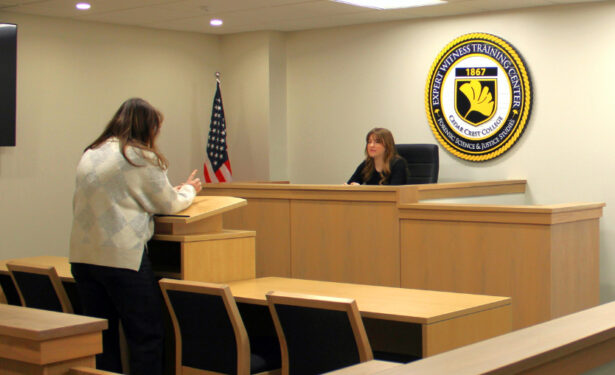
Expert Witness Training Center
Students studying in our Forensic Science, Crime Science, Criminal Justice, and Social Work programs experience hands-on training in the state-of-the-art simulation spaces at the Joni Berner, Esq. ’75 Expert Witness Training Center. Designed for immersive, real-world training, these spaces prepare students for crime scene analysis, forensic laboratory work, and providing courtroom testimony while facilitating hands-on learning from industry experts.
How To Apply
Ready to apply as a graduate student?

Accreditation

Cedar Crest College is accredited by the Middle States Commission on Higher Education; 1007 North Orange Street, 4th Floor, MB #166, Wilmington, DE 19801
Faculty & Staff
Who’s teaching you is as important as the curriculum you choose.
Let’s put a face to some of the names you’ll be seeing on the course listings!

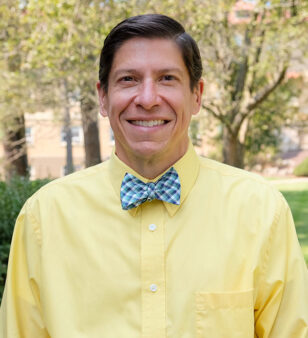
John Lichtenwalner
Assistant Professor of Social Work


- School of Adult and Graduate Education
- sage@cedarcrest.edu
- P: 610-740-3770