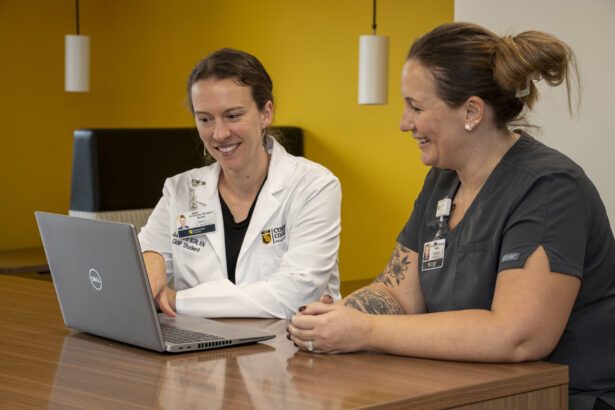
You have the experience, now build the skills to share it. Cedar Crest’s Post-Baccalaureate Certificate in Nursing Education prepares baccalaureate-educated nurses to become effective nurse educators in academic and healthcare settings.
Whether you’re already guiding students in clinical settings, educating staff, or considering a transition into teaching, this program equips you with the knowledge and skills to excel as a nurse educator.
We see you make a lasting impact—on students, patients, and the future of nursing.
Inspire Future Nurses
Designed for BSN-prepared registered nurses passionate about shaping the future of healthcare, this fully online certificate equips you with the skills to teach and inspire the next generation of nurses. The program prepares nurses to more effectively precept, mentor, and teach nursing students, including learners in select pre-licensure nursing programs.
Through coursework in curriculum development, innovative teaching strategies, assessment design, and program evaluation, you’ll gain the tools to create impactful learning experiences for nursing students and healthcare professionals alike.
Develop the educational expertise needed to guide future nurses while creating a clear pathway to your master’s degree.
This 12-credit certificate also serves as a pathway to Cedar Crest’s MSN in Nursing Education, allowing students to apply certificate credits toward the master’s degree.
Program Snapshot
12 credits
100% online
Asynchronous coursework
No clinical requirement (all didactic coursework)
Spring and Fall entry
The Cedar Crest College Online Advantage
Flexibility: Designed with working nurses in mind, coursework is offered in an online, asynchronous format.
Our reputation: When you become a part of our School of Nursing, you become part of a long tradition of modern nursing. Cedar Crest nurses are known throughout the area for their competence, care, and compassion.
An Accessible Certificate
Our Nursing Education certificate was designed for working healthcare professionals, providing the flexibility to advance your education without interrupting your career. The fully online, asynchronous format lets you balance work, life, and your studies—all while completing your program in just four semesters.
Year
Completion Rate Aggregate
First Time Certification Exam Pass Rate
(Aggregate for MSN/ PMC NP options)
Ultimate Pass Rate (Includes Repeat Testers)
(Aggregate for MSN/ PMC NP options)
2022
ACEN 67%
CCNE 87.5%
80%
100% (15/15)
2023
ACEN 67%
CCNE 87.5%
85%
91% (10/11)
2024
ACEN 60%
CCNE 86%
85%
100% (13/13)
2025
ACEN 45%
CCNE 71%
100%
100% (4/4)
On Time Completion Rate (by Program)
Year
Master’s
Post Master’s Certificate
DNP
2022
Nurse Educator
67%
n/a
Nurse Administrator
n/a
n/a
FNP
67%
100%
n/a
AGACNP
67%
n/a
n/a
2023
Nurse Educator
57%
n/a
Nurse Administrator
66%
n/a
FNP
70%
n/a
n/a
AGACNP
60%
100%
n/a
2024
Nurse Educator
n/a
n/a
Nurse Administrator
n/a
n/a
FNP
60%
n/a
n/a
AGACNP
75%
n/a
n/a
2025
Nurse Educator
100%
n/a
Nurse Administrator
n/a
n/a
FNP
80%
n/a
n/a
AGACNP
0%
n/a
n/a
Integrate knowledge of theory and research to develop a comprehensive and ethical approach for nursing practice, education, and administration in a global society.
Utilize advanced clinical knowledge and skill to promote, maintain, and/or restore optimum wellness to clients.
Articulate the issues and trends that affect the social, economic, political, and institutional forces that influence nursing and health care delivery.
Critically appraise and utilize scientific, expert, and other sources of knowledge to ensure quality outcomes in the context of evidence-based practice.
Develop collaborative and interprofessional relationships to improve health outcomes in a variety of settings.
The technical standards for the Cedar Crest College School of Nursing outline the essential skills and competencies required for both undergraduate and graduate nursing students to provide high-quality, compassionate patient care. These standards emphasize the acquisition of both foundational and advanced knowledge in clinical reasoning, healthcare systems, and evidence-based practice. Undergraduate students must demonstrate the ability to synthesize information, communicate effectively, and apply clinical judgment in patient care. Graduate students build on these skills by integrating complex theoretical knowledge, analyzing data, and making informed, evidence-based decisions. Both levels require proficiency in using technology, patient-centered care, and maintaining professionalism and lifelong learning. Students must also be able to perform essential technical skills and procedures, with accommodation provided as necessary to support individual needs and ensure equitable access to meet these requirements. The College provides reasonable accommodations to students on a nondiscriminatory basis consistent with legal requirements as outlined in the Americans with Disabilities Act (ADA) of 1990, the Americans with Disabilities Act Amendments ACT (ADAAA) of 2008, and the Rehabilitation Act of 1973. If you are an applicant with a disability who may require accommodations in our program, we encourage you to contact Student Accessibility Services at for a confidential consultation.
Graduate Nursing Programs Technical Standards
Acquiring Fundamental Knowledge
Theoretical Foundations: Graduate nurses must successfully complete advanced education in subjects such as pathophysiology, pharmacology, and health assessment. This knowledge forms the basis for understanding complex patient care by delving into theoretical frameworks to develop effective clinical reasoning skills.
Current Research and Trends: Graduate nursing students must stay current with the latest research and emerging healthcare trends to provide high-quality evidence-based care. Critical appraisal, synthesis and translation of scientific evidence informs best practice.
Healthcare Systems Knowledge: Graduate nursing students must understand the structure, policies, and functions of healthcare systems to enable them to navigate the complexities of patient care within different settings.
Developing Communication Skills
Effective Verbal Communication: Graduate nurses must master the ability to communicate clearly and effectively with patients, families, students, preceptors and the healthcare team. This includes active listening, providing patient education, and navigating sensitive discussions with compassion and clarity.
Nonverbal Communication: Graduate nurses must recognize and effectively utilize body language, facial expressions, and other nonverbal cues as important for building rapport and ensuring understanding. This is demonstrated by congruency between verbal communication and nonverbal expression, with consideration of diverse cultural mores.
Documentation Skills: Graduate nurses must demonstrate proficient writing skills. This is necessary for accurate and thorough documentation of patient care, transitions of care, research, scholarship, and legal compliance.
Interpreting Data
Clinical Data Analysis: Graduate nurses must be skilled in analyzing and synthesizing clinical data from various sources, including patient histories, diagnostic tests, and monitoring systems. This involves identifying patterns and anomalies that inform care decisions.
Use of Technology: Graduate nurses must be familiar with electronic health records (EHRs) and data management systems, as well as adept at using technology to enhance data interpretation and patient care.
Quantitative and Qualitative Analysis: Graduate nurses must understand that the analysis of both quantitative and qualitative data is important for making comprehensive clinical assessments and engaging in research activities.
Integrating Knowledge to Establish Clinical Judgement
Holistic Assessment: Graduate nurses must be able to conduct thorough assessments that consider physical, psychological and socio-cultural factors affecting patient health. This holistic approach informs clinical judgment and decision-making.
Application of Theoretical Knowledge: Graduate nurses must integrate knowledge from various disciplines (nursing, medicine, psychology, sociology, education) into clinical practice to make informed decisions that are patient-centered and evidence-based.
Ethical and Legal Considerations: Graduate nurses must incorporate ethical principles and legal frameworks into clinical judgment to ensure that care decisions respect patient autonomy and adhere to professional standards.
Implementing and Evaluating Nursing Interventions
Evidence-Based Practice: Graduate nurses must be able to select and implement interventions based on the most relevant and current evidence. This includes utilizing clinical practice guidelines and evidence-based protocols to inform their actions.
Patient-Centered Care: Graduate nursing level care should be tailored to meet the individual needs and preferences of patients. This involves engaging patients in their plans of care and considering their values and beliefs.
Outcome Evaluation: Graduate nurses must evaluate the effectiveness of nursing interventions. Graduate nurses must be skilled in assessing patient outcomes, adjusting plans of care as necessary, and using feedback to improve practice.
Incorporating Appropriate Professional Attitudes and Behaviors into Nursing Practice
Professionalism: Graduate nurses are expected to demonstrate professionalism through reliability, accountability, and adherence to ethical standards. This includes maintaining patient confidentiality, advocating for patients’ rights and contributing to a safe, collegial workplace. Graduate nurses must uphold high standards of honesty, integrity, ethical behavior, and advocacy for the nursing profession as a whole within interdisciplinary teams.
Compassion and Empathy: Graduate nurses must be committed to providing compassionate care. Graduate nurses must cultivate empathy and understanding to address the physical, psychological and socio-cultural needs of patients.
Lifelong Learning and Adaptability: Graduate nurses must embrace a mindset of lifelong learning to adapt to the evolving healthcare environment. Graduate nurses should actively seek opportunities for professional development and be open to feedback and change.
Post-Baccalaureate Certificate in Nursing Education Admission Requirements
To be considered for admission to the program, applicants must meet the following requirements:
Completion of a bachelor’s degree in nursing awarded by an accredited college or university. Applicants may apply while finishing their bachelor’s degree requirements, however the degree must be conferred, as shown on an official transcript, prior to the start of the student’s first matriculated semester at Cedar Crest College.
Minimum BSN GPA of 3.0 (on a 4.0 scale). However, applications are reviewed holistically, and applicants with a GPA below 3.0 may be granted conditional admission at the discretion of the program director if their application materials demonstrate the potential for success in the program.
One year of clinical experience preferred but not required
Completion of an interview with the Director of the program and/or representatives from the Graduate Nursing Program Committee.
Graduates of the Cedar Crest College School of Nursing who meet program admission requirements are eligible for direct entry into the program. Applicants must submit an admissions application and official transcripts from any institutions attended after graduating from Cedar Crest College. All other application requirements, including the interview with the program director, are waived.
Tuition Reduction
Tuition for the Master of Science in Nursing (MSN) and Doctor of Nursing Practice (DNP) programs have been reduced beginning in the Fall 2024 semester, making them comparable to similar nursing programs in the Lehigh Valley.(Note: ABSN and CRNA programs not included)
Cedar Crest College collaborates with several academic institutions to provide our students with innovative pathways that help them succeed in their chosen fields.
Visit the gallery show “Hello It’s You” by Lance Rautzhan this fall, with an Artist Talk/Reception taking place Sept. 10 from 5:30 to 7:30 p.m. The gallery system at Cedar Crest College contributes to the cultural quality and overall experience…